Thursday, November 13, 2014

Jessabelle (2014) : Back To The Bayou For Some Voodoo

Films with voodoo intertwined in the plot are far and few between, yet I always yearn for more.  My absolute favorite within the sub-genre, Angel Heart,  just simply can't be beat for plot, acting, atmosphere, score, and let's face it -the movie just looks fantastic!  So the bar has been set pretty high for me since oh, let's say...1987.   There have really only been a handful of semi-decent voodoo flicks since then, such as The Believers (also 1987, and really about Brujería [hoodoo] but close enough for me), The Serpent and the Rainbow (1988, one of my guilty pleasures!), and The Skeleton Key (2005, which I always thought was a little underrated). Child's Play (1988) does have an element of voodoo since Charles Lee Ray practiced the religion and used a voodoo ritual to transfer his soul into a Good Guy doll, but they really didn't delve into the darker elements like these other films.

So when Jessabelle was making the trailer rounds, I was intrigued and perhaps even excited to check it out.  I never get my hopes up in watching a new horror film - though I still can't get enough of them - that way if it turns out to be good I am pleasantly surprised.  There haven't been a lot of surprises lately.  Hmpf!  Jessabelle doesn't do a whole lot to make the movie feel fresh at all, and in using the same old rhetoric and plot devices it fails to evoke any serious scares and falls well short of the aforementioned films. That said, there was enough going on within the hour and a half running time to keep my interest and semi-enjoy it.

The titular character Jessabelle (Sarah Snook) and her fiance are moving in together as the film opens.  They are obviously in love and excited to begin their new life together.  After loading the last of Jessie's belongings into their pick-up truck, they take off down the road of life....only to be involved in a devastating car crash that kills the fiance and (temporarily) paralyzes Jessie from the waist down. To add insult to injury, Jessie doesn't just lose the love of her life and her ability to walk - she loses the unborn child they were preparing for.

Her mother died of a long illness when Jessie was a baby and even though she hasn't set eyes on her father Leon (David Andrews) in years it is him that she is forced to call to pick her up at the hospital upon discharge.  Leon takes her back to his house deep in the Bayou and sets her up in her mother's old room - which has been strangely blocked off with a large cabinet for a seemingly long time.

In her new room she finds several of her mother's things, including a deck of tarot cards and a box with videocassettes in it.  More than curious, she watches the first tape to find her mother (Joelle Carter, Justified) doing a reading and speaking to her unborn child (Jessabelle).  The first card she turns is Death, but her mother explains that just means transformation.  The unsettling reading ends with Jessie's mother telling her that there is a presence in the house that doesn't want Jessie there.  When Jessie's father finds out what she's watching he seizes the tape and throws them in the trash then proceeds to take her wheelchair outside, wheel it down to the dock and throw it into the bayou.

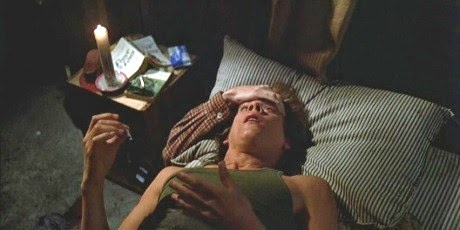
Apologetic in the morning, her father presents her with her mom's old wheelchair and warns her that the tapes are not good for her to watch and that her mother had crazy ideas.  After he leaves for work Jessie is alone in the house and starts to experience some strange, even paranormal events.  When a therapist comes and helps her into the tub for a bath, Jessie falls asleep but is awakened and pulled under water by a malicious female spirit, who then seems to be screaming at her in every reel from then on.

She finds another hidden videotape and scares herself silly when she realizes her mother was either correct about someone being in the house - or she actually was crazy.  Maybe a little of both.  Her father is furious to find her watching another tape and he takes them outside to burn them.  Things go awry and somehow he ends up in his work-shed with a raging fire all around him. At his funeral (its' really not giving anything away to mention his death), Jessie reconnects with an old high school boyfriend, Preston (Mark Webber).  She starts to tell him about the strange events and they begin doing some research into the past. It's obvious Preston still has a thing for Jessie, but just when you think they are going to quickly couple up we are introduced to his wife. 

Preston continues to help her despite the scowls and torments of his wife, and their search leads them to a grave on the other side of the bayou on the property.  When they uncover the name, and it says Jessabelle - with Jessie's exact birth date, it's clear that malevolent forces are at work here.

I wanted to love Jessabelle.  I really did.  But now I know I am destined to only just tolerate this recent venture into voodoo.  All things told, it really incorporated too many different ideas in one film - I had way too many unanswered questions.  Was Jessie's mother a voodoo priestess?  A witch?  Do voodoo practitioners use Tarot cards?  Why were there evil spirits?  Was the house itself haunted?  Or was the apparition supposed to be a demon?  Was someone possessed by the devil or was it a voodoo possession - which is allegedly a good thing in voodoo? Did I not pay close enough attention and miss something profoundly important?

Regardless, I didn't hate it. The atmosphere of a steamy, shadowy bayou was ever-present.  Is anything creepier than all that Spanish moss hanging from the trees over the brackish water of the dark bayou? No matter how you spin it, that area of Louisiana just screams spooky.
Sarah Snook, for being an Aussie, does a pretty good job of spinning that cajun accent, and does emulate well a frightened young woman with all kinds of questions and nothing to lose.  But there just wasn't enough actual voodoo.  I was looking for loads more secret rituals, inexplicable transformations - maybe even a few zombies for pete's sake!
But instead all I was left with was hopes and dreams for the next voodoo film that comes along.

Sunday, November 2, 2014

Beneath (2014) : When Fear Meets Madness Below The Earth

I live in the coal-mining region of the Appalachian Mountains in the eastern US.  This area is home to thousands upon thousands of underground mines, and in turn employs hundreds of thousands of coal miners.  Some houses in my and neighboring towns are built on old mines and at times, have sunk into the earth. There is (at least in my opinion) a ridiculous amount of cancer in this area.  Lung cancer and emphysema from breathing in the coal dust, as well as other cancers you'll have a hard time convincing me isn't caused by all the noxious fumes and pollution the earth and water sources are forced to consume as they settle into the ground. That said, this is a very proud area, where lives are built and families are raised due to the coal industry.  It's a dying industry, to be sure, but nonetheless it is the backbone of the Appalachians. 

This little history lesson does have a point.  If you want to scare someone from this area whose lives are already touched by coal mining, make a horror movie about a mining accident.  Mining disasters, collapses, cave-ins - they are all a part of life here and miners know the chance they take every time they go under the ground.  There really couldn't be anything scarier, in my opinion.  Except maybe if you made a movie about it.  You've got everything a horror fan could possibly need.  Dark, dank and creepy? Check.  Extremely dangerous? Check.  Claustrophobia? A BIG check.  Stuck in a helpless situation? Check. People losing their mind, hallucinating, and resorting to murder? Check (oxygen depletion will do that to a person).  Possible supernatural element?  Check....

Most horror fans have seen My Bloody Valentine.  And many horror fans have seen The Descent.  I don't think it's me going out on a limb to say Beneath is kind of a lesser mash-up of these two films.  While it will never match The Descent's balls-to-the-wall dose of claustrophobia, and it doesn't have the blatant (and sometimes unintentional) humor of MBV, it does stand on its own as a decent flick to check out on a random Saturday night. 

Samantha Marsh (Kelly Noonan) is back in her home town to see her father George (Jeff Fahey), who is ending his long mining career and doing some celebrating with co-workers on the night before his last dig.  This coal miner's daughter moved away and became (much to the chagrin of George's fellow miners) an environmental lawyer.  Partying lends way to teasing and eventually George's fellow miners daring Sam to come into the mine on George's last day.  Sam's old boyfriend Randy (Joey Kern) isn't too keen on the idea - and some of the older men are a bit rattled when Sam agrees to go, saying it's bad luck for a woman to be down in the mine.

But off they go, greeting the hesitant sunrise as they drive to the mine early the next day.  Randy advises Sam to "say goodbye to the daylight" as they descend into the mine, and you can feel Sam's uneasiness kick into full gear.  Naturally, you already can surmise something tragic is about to take place, and it does.  When one of the miners accidentally drills through a support wall, he triggers a collapse, leaving some men dead or separated from the others and unaccounted for, with the remaining miners trapped.

Luckily, those that are together are in the same vicinity as the "condominium", a large metal container filled with supplies and enough oxygen to keep survivors alive for 5-6 days - which should be ample time considering communication with the world above leads them to believe they will be rescued within 72 hours.  So they settle in to the tin box, which itself seems even more claustrophobic than the mine, and fix up the nasty fracture of one of the older men. 

When they start to hear sounds coming from outside the container, they assume it could be coming from miners still trapped in the tunnels and several of the men leave in search of survivors.  As is oft the case in horror films, people become separated and suffer the consequences of being alone.  What we are teased with here though, is not just the fact that Sam and the men are becoming more oxygen depleted by the moment, but also that there may be something preternatural at work here.  A story told about a group of 19 miners who were lost in a cave-in during the 1920's lends a hint of nostalgic terror to the movie, and makes the viewer start thinking about possible supernatural elements presenting themselves. Is something else down there in the depths of the earth with them? 

The otherworldly are always more dreadful when enclosed in small spaces. Movies like Below (terror on a submarine), Devil (in an elevator), The Last Winter (at a drilling base in the Arctic) and the aforementioned The Descent (in a series of endless caves) are proof positive that you don't want to be in close quarters with any type of paranormal activity.  (In fact, if claustrophobic horror has your interest piqued, check out this post.)

The decision of going forward to look for fellow lost miners or staying put to try to save themselves and conserve oxygen brings morality into the film as well.  But when things start going awry at the container, all bets are off and the dwindling group heads deeper into the mine to search for other survivors, discover a way out, or run out of oxygen and die within the dark mine shaft.

Effects in the film are minimal, but what is there is good.  An early leg fracture is grisly, as are a few pick-axe injuries that spill insides and crack skulls.  Ghostly effects are good as well, not too overdone and not too many that it gets mundane.  Acting skills are noticeable as well, with Fahey wheezing and coughing his way through most of the picture and Kern delivering believable concern for his fellow co-workers and later fear as the O2 dwindles and the body count rises.  Noonan, as Sam, is a convincing big-city girl stuck in Hickville, USA, and not fitting into the hometown scenario anymore.  But her love for her father is palpable and her terror regarding her questionable fate is easily seen.  Again, I wouldn't say her acting is quite up to the standards of the majority of the female "Descent" cast, but she does hold her own.

We are meant to be a bit confused by Beneath at times, I think.  Are the hallucinations that present themselves ghosts?  Or are they they product of very little oxygen and a whole lot of mind-tricks? I can think of nothing more terrifying than knowing you are trapped 600 feet underground and your oxygen supply is little to none.  I assume there would be a certain amount of denial, which we are shown by Sam here.  And as that wavers and fate is realized, acceptance would set in.  That's something we can deal with.  Optical illusions that may or may not be ghosts of miners long lost - that's another thing altogether.

One minor annoyance is the film tagline, "based on true events".  Hmm... If I had a quarter for every time I saw that I would be buying that new 4-door Jeep Wrangler I have my eye on.  That ridiculous statement dumbs down nearly any film it is attached to.  Think about it.  No really... The Amityville Horror, The Haunting in Connecticut, The Entity, The Mothman Prophecies, The Serpent and the Rainbow....I could go on. And on. But I won't.   Hey, we can't all be The Descent.

Regardless, I enjoyed this little flick well enough. Coal mining is a brutally unforgiving job, wrought with injury, anxiety, and a sometimes hopeless future, so when you add in the supernatural factor, it's bound to scare me well enough.  I've always been a huge fan of MBV, campy or not - so another film set in a mine was bound to be gold to me.  See what I did there?

Friday, October 31, 2014

Festival Of Fear: Day 31: ~ Roots Of Hallowe'en

~by Marie Robinson

While I’m sure almost all of us will be celebrating Halloween today (hooray!), very few of you will still be honoring the Pagan holiday of Samhain (sah-win), which begins tonight at sundown. Celebrated in Celtic countries, Samhain marked the beginning of winter and many rituals and festivities took place over the night.

Although Samhain was a time to prepare for winter, it was also very much a festival of the dead, as the Irish believed that on this night the doorways to the Otherworld opened and spirits were allowed access into our realm.

It was believed that dead family members would return to their homes to warm themselves by their fireside so a fire was, of course, kept roaring, and a place at the table was sat for the ghost. The sídhe were also free to walk the Earth on Samhain; the sídhe are a race of supernatural beings that come in many forms, but are all essentially nature spirits, or, in other words, faeries, elves, goblins and that sort of thing.


The Irish have utmost fear and respect for the sídhe and would take great care to make sure they were comfortable on Samhain. They would place offerings of their doorsteps in the form of food and drink in hopes that the sídhe would help their crops to prosper next harvest. Trick ‘r’ treating comes directly from a symbolic ritual that the Celts would perform on Samhain.

People would dress up in costumes—that were, rather, disguises to hide their human selves from the sídhe—and go house to house singing Pagan songs or reciting poetry. The owner of the house was then expected to reward them with food (which was gathered for a enormous feast), and if they did not, bad luck was sure to come upon them.

The sídhe love to play tricks and fool people, so, naturally, if one is dressed up as one of the sídhe they may as well act like one, and because of all the prank playing Samhain eventually gained the nickname “Mischief Night”. In modern times Mischief Night is commonly celebrated the night before Halloween and teenagers are encouraged to go out and perform pranks such as TP'ing houses. In Canada it is called Devil’s Night.

While some spirits were welcomed to return, there were also many precautions taken to keep dark forces at bay; the most famous one now being jack-o-lanterns (also made out of turnips), which were hollowed out and lit to intimidate evil spirits and frighten them away. Huge bonfires were lit on the night of Samhain to keep spirits away, and smoke was thought to cleansing and protecting.

If one is walking down the road on Halloween night and hears someone walking up behind them, they must not turn around, for if they do they could look Death in the face, therefore quickening their own timeline to the grave.

Those born on Halloween are given the gift of second-sight, the ability to see ghosts and faeries. They are also granted protection from them.

On Samhain and Halloween there were many ways to tell the future, and many strange ways to go about doing it. Some of the more easy ways are going to a crossroads, and in the voice of the whispering wind you will hear tell of events in the upcoming year. If you visit a churchyard when the clock strikes midnight, you will hear a voice list out the name of locals who will die within twelve months.

The divination rituals dealt almost exclusively with death and marriage. In aspect to the latter, a girl who looks in the mirror while combing her hair and eating an apple may catch a glimpse of her future husband’s image in the mirror. There are a handful of traditions that involve apples, including the tradition that has now become bobbing for apples. A long time ago the children used to take the apple they plucked out of the bucket home with them to put under their pillow, in the hopes that in their sleep they would be visited by their future spouse.

While many of the core themes and traditions of Samhain still exist today, few may know the origins behind them. For me, knowing the roots of the legends makes them even more magical and makes me enjoy my favorite day of the year even more.

 Happy Halloween everyone, and thank you for joining us in another year's festival of fear!

Thursday, October 30, 2014

Festival Of Fear: Day 30 ~ Terrible Tortures, Part 5

And finally, we've reached the end of our exhaustive, quite extensive lists of torture methods and devices.
What are you waiting for...... Here we go.

45) TORTURE CHAIR (a.k.a. JUDAS CHAIR, IRON CHAIR) - One of the most evil-looking forms of torture was a chair covered in spikes in which a prisoner would be forced to sit.  The torturer would then tighten the restraints in order to push the sharp points into flesh.  Worse yet, they were often made to endure an even worse fate when the chair would be placed over hot coals or a fire and the victim would slow-roast to death.

46) THE BRAZEN BULL - Invented in Ancient Greece, this device was a life-sized statue of a bull which was hollow to hold a prisoner/victim.  They would then be locked in and the bull would have a roaring fire lit underneath it, causing the victim to burn alive.  Even more creative was when a series of hollow tubes were added so that the screams of the dying victim would sound like an angry bull. 

47) STONING - Dating back to Ancient Greece, stoning has long been a form of capital punishment the world over and remains in use to this day. It is rather self-explanatory: victims have stones thrown at them until they die. In similar fashion, Giles Corey was pressed to death during the Salem witch trials of 1692. His accusers laid heavy stones on top of his chest and kept adding to try to force a confession of witchcraft from the man.  He refused, and died after 32 boulders were laid on his body, forcing his insides out through his mouth, ending his life.

48) BURNING ALIVE - Speaking of witchcraft, this form of execution was used before accused witches were burned at the stake, and well before the time of Christ. It continues to this day in various incarnations. Some of the various torturous deaths: the Celts used wicker men (yes, just like the movie!), Ancient Romans burned Christian martyrs alive by dipping a tunic in wax and setting them on fire, arsonists in Germany were placed in a wooden chamber which was then filled with sulfuric smoke and set on fire, and of course, witches during "the Burning Times" were simply burned alive at the stake.  A few of the previous methods were discussed within this series also, like boiling alive, necklacing, and number 42 on this list, the Brazen Bull. There seems to be no end to the ways to burn a person.

49) DEATH BY ANIMAL -  Fairly self-explanatory, this type of torture and death was used for thousands of years.  From throwing a man to the lions, pitching a poor soul into a pit of venomous snakes, goring someone with a bull, and my personal favorite: death by elephant.  That one involved having an elephant crush your head like a melon with his foot.  Sometimes they crushed each limb first, then the abdomen, to make it take longer and hurt more.

50) HERETIC'S FORK - This was an iron device with two forks, one on each end, and secured by a collar or leather strap.  It would be placed to fit between the victim's upper chest and chin, and did not allow any movement whatsoever, lest the victim's soft flesh be punctured by the sharp points. The victim's hands were tied behind their back to restrict movement.  It was often used for sleep deprivation because if the victim moved, they would immediately be jarred back to the reality that was their torture.

51) ABACINATION (EYE TORTURE) - This is the purposeful blinding of another person as a form of torture. Simply put: a red hot metal plate is placed over the eyes to burn them shut.  Blinding has been used since before the Dark Ages as a form of torture.  It was also common to put lime in paper cups and fasten them to the eyes so that the corrosive agent eats the eyeballs.  Some tortures included pouring molten silver directly into a victim's eyes. And there was always the gouging out of eyeballs.  Director Lucio Fulci made a habit of including eye torture in many of his films.

52) LEAD SPRINKLER - What at first looks like a device used to sprinkle holy water actually has a much more sinister purpose.  The sprinkler would be filled with hot liquid like tar or oil -  or molten metal and it would come out the end with the holes and onto the victim.

53) CEMENT SHOES - The American Mafia started this tradition of execution.  The victim (usually someone who has been a rat or has harmed the family in some way) has both feet placed into the openings of a cinder block, or even in a bucket - and then cement is poured all around.  It is left to harden and then the victim is simply dumped in the river or some other body of water and quickly drowns.  It is where the mob phrase "sleeps with the fishes" came from.  Not pleasant.

54) SPANISH TICKLER (or CAT'S PAW) - Very similar to the Breast Ripper, this device was either a three or four pronged device that resembled a claw.  It was either on a handle or attached to a long stick so that it could be raked across bare flesh causing critical  injuries, as you can imagine.  It was oft times fatal due not to the wounds themselves, but because of the severe infections that would result from the skin being laid open.

55) ASIAN BAMBOO TORTURE- Seriously.  This is just wrong. Whether or not it was actually used or just an urban legend can't be proven, but what happens is this:  a victim is suspended horizontally over a patch of bamboo stalks that have been sharpened to a point.  Bamboo grows extremely fast, and would soon pierce through the victim's skin and grow through the body and out the other side and continue upward.


*Well, hope you enjoyed this tour of torture methods.  There were so many different types out there that I had to only pick fifty-five out of the bunch...It's sad that the world has devised so many ways to cripple and kill someone over the centuries.....

Tuesday, October 28, 2014

Festival Of Fear: Day 28: True Story Tuesday: The Haunting In Connecticut

The 2009 film The Haunting in Connecticut is one of those that boasts the famous tagline of, “based on a true story”. But how true is the story? And who are the world-renowned paranormal investigators that made this tale famous?

The Haunting in Connecticut was based on the story of the Snedeker family, who moved to Southington in 1986 in order to get treatment for their eldest son, Phillip, who had cancer. Desperate to find a home, they unknowingly moved into a former funeral home.

The Snedeker home in CT
The mother, Carmen, was left alone to take care of the house and the kids since her husband had to remain at his job, hours away. She was busy and reluctant to believe her children’s (three boys and a girl) claims of supernatural activity. It started with Phillip hearing voices calling his name at night, and then seeing apparitions in his room, which was located in the basement beside the embalming room. His brother, Brad, who also shared his room would see them on occasion as well. While Phillip most commonly saw a man, he once awakened Brad to point out four cloaked men standing in the corner of their room. After a thorough search by their mother, the house was found empty.

Carmen was becoming suspicious by the crucifixes (which were hung above every doorway in the house) disappearing one by one. Eventually she began seeing apparitions in the house, as well, such as a girl with long black hair and a man in a pinstripe suit with white hair and white eyes.

Scene from The Haunting in Connecticut
Phillip began to noticeably change, and became withdrawn, moody, and violent. He would spend hours in his room—which became the embalming room after he moved himself into it—scribbling in a notebook that was later discovered to have pages of dark thoughts, drawings, and poems of a devious and disturbed nature. When his mother questioned him on how he could have written some of the material, since he was apparently dyslexic, he claimed “the man” helped him do it. Phillip began cutting bizarre, occult-like symbols into his arm, which was apparently also the instruction of unseen entities.

It wasn’t until after an older female cousin, Tammy, moved in, that things truly escalated. Once close with Phillip, she was now frightened of him and would find him staring at her from around corners. Tammy was pestered at night by unseen entities which were pulling at the covers and her clothes. Believing it was Phillip (and some accounts say it was Phillip), Carmen had her son committed and treated for schizophrenia.

~from the TV show Paranormal Witness
However, activity did not cease in his absence; on the contrary it intensified. Tammy was still attacked at night, and could even see disembodied hands running under her nightgown. Tammy, Carmen, and even father Al claimed to be sexually assaulted by the demons they believed inhabited the house. It was after repeated incidents that they called in renowned psychic and demonologist, Ed and Lorraine Warren.

After staying in the house for several weeks and experiencing all that the family did, the Warrens decided to perform an exorcism, which apparently brought an end to the horror. Phillip was released from the institution and the family moved out of the home. Phillip’s cancer took his life at age 24. Since their haunting, the family—particularly Carmen and youngest son AJ—have gone on to tell their story in many different forms, and perhaps many different versions, too.

They got attention with the book In a Dark Place, written by Ray Garton. Carmen and her family have relayed their story on episodes of A Haunting and Paranormal Witness; she now considers herself a spiritual advisor and plans on writing another book.

Although the Snedeker account is terrifying and gripping, many also believe that it is fake. Tenants who occupied the house before and after the famous family have had no reports of supernatural activity, nor has the landlady, who also claims that the Snedekers were aware of the former use of their home. More concerning is the fact that the author of their supposed biography, Ray Garton, doesn’t believe the story to be true. He was hired by the Warrens to interview the family and pen the tale, but was bothered when the family’s accounts were inconsistent and contradictory. When Garton expressed this issue to Fred Warren, he assured Garton that the family was “crazy” and to use what he could and make up the rest, but to be sure to make it scary. So that’s exactly what Garton did.

How much of the Snedeker’s story do you believe? Were they in it for the profit or were they truly tormented by inhuman spirits? Does The Haunting in Connecticut deserve their controversial tagline?